Book your Online Consultation

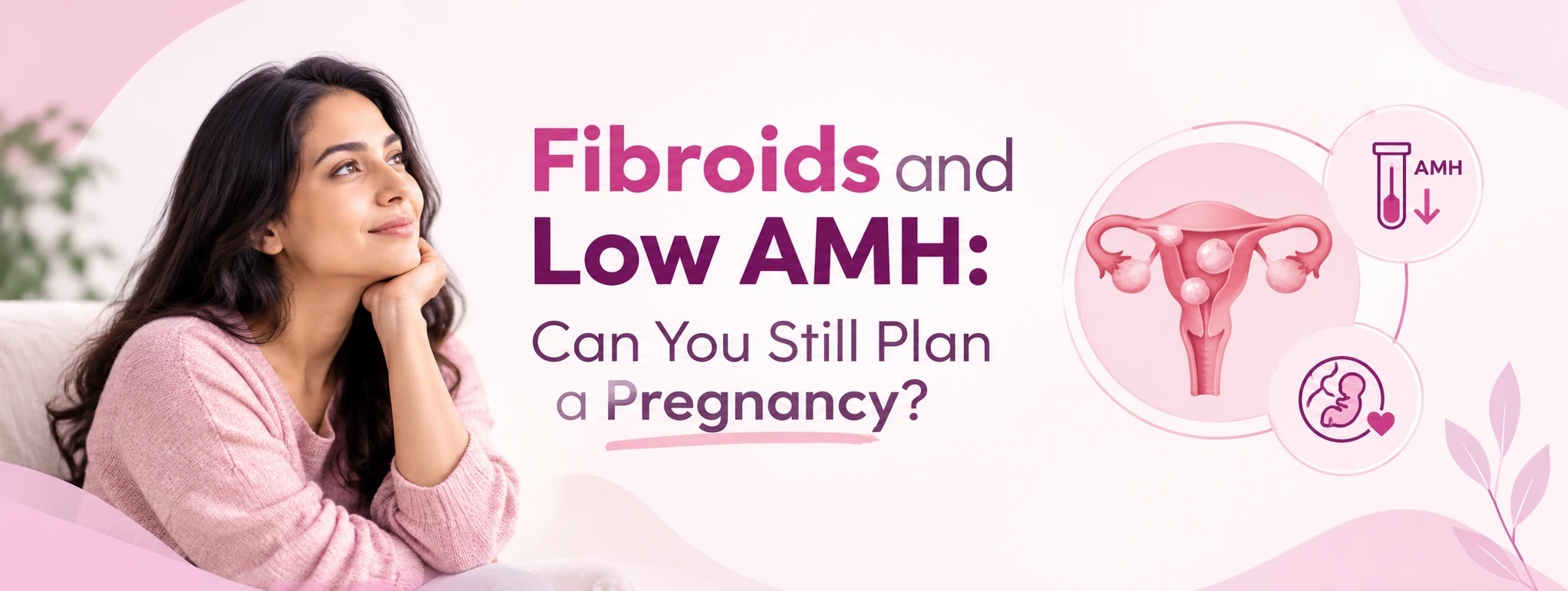
Hearing “you have fibroids” and “your AMH is low” in the same consultation can feel overwhelming. Many women immediately wonder whether pregnancy is still possible.
The short answer is that many women with fibroids and low AMH can still plan a pregnancy. The right approach depends on your age, the type and size of your fibroids, and your overall fertility picture. This guide explains how the two conditions interact and what your options are.
What Are Fibroids?
Uterine fibroids are non-cancerous growths in the muscle wall of the uterus. They are very common, especially in women in their 30s and 40s. Some cause no symptoms at all, while others cause:
- Heavy or prolonged periods
- Pelvic pain or pressure
- Frequent urination
- Difficulty conceiving or repeated pregnancy loss, in some cases
What Does a Low AMH Mean?
Anti-Müllerian Hormone (AMH) is produced by the follicles in your ovaries. A blood test measures it, and it gives an idea of your ovarian reserve, which is roughly the number of eggs remaining.
A low AMH means:
- You may have fewer eggs than is typical for your age
- You may respond with fewer eggs to fertility treatment
A low AMH does not automatically mean you can’t get pregnant. It tells us about the quantity of eggs and doesn’t fully measure their quality. Age remains one of the strongest factors in fertility.
Are Fibroids and Low AMH Connected?
Fibroids don’t directly cause low AMH, and low AMH doesn’t cause fibroids. They are separate conditions that often appear together simply because both become more common with age.
However, they can affect each other’s management:
- Fibroids can affect the uterus by changing the cavity shape or blood supply, which can make it harder for an embryo to implant.
- Low AMH makes timing important, since there may be less room to wait before treatment.
- Some fibroid treatments need care. Certain procedures, such as uterine artery embolisation, may affect ovarian blood supply, so your doctor will weigh this up.
Do All Fibroids Affect Pregnancy?
No. Their effect depends mostly on location:
- Submucosal fibroids (inside the uterine cavity) are most likely to affect fertility and implantation, and are often recommended for removal.
- Intramural fibroids (in the muscle wall) may affect fertility if they are large or distort the cavity.
- Subserosal fibroids (on the outer surface) usually have the least effect on fertility.
Small fibroids that don’t change the cavity often need no treatment before pregnancy.
Can You Still Get Pregnant?
Yes, in many cases. Your chances depend on:
- Your age, which strongly affects egg quality
- Your fibroid size, number and position
- Your AMH level together with other tests, such as antral follicle count (AFC) and FSH
- Your partner’s fertility and your overall health
Some women conceive naturally, while others need assisted options such as IUI or IVF.