Book your Online Consultation
Introduction
When trying to conceive, understanding your menstrual cycle can help you identify the days when pregnancy is most likely. Two terms that often create confusion are fertile window and ovulation. Although they are closely connected, they do not mean the same thing.
Ovulation refers to the release of an egg from the ovary, while the fertile window is the period during which intercourse can result in pregnancy. Knowing the difference between these two can help couples understand their most fertile days and plan pregnancy more effectively.
In this blog, we explain what the fertile window and ovulation mean, how they are connected, how to identify them, and when to seek guidance from a fertility specialist.
What Is the Fertile Window?
The fertile window is the period during the menstrual cycle when a woman has the possibility of becoming pregnant through sexual intercourse.
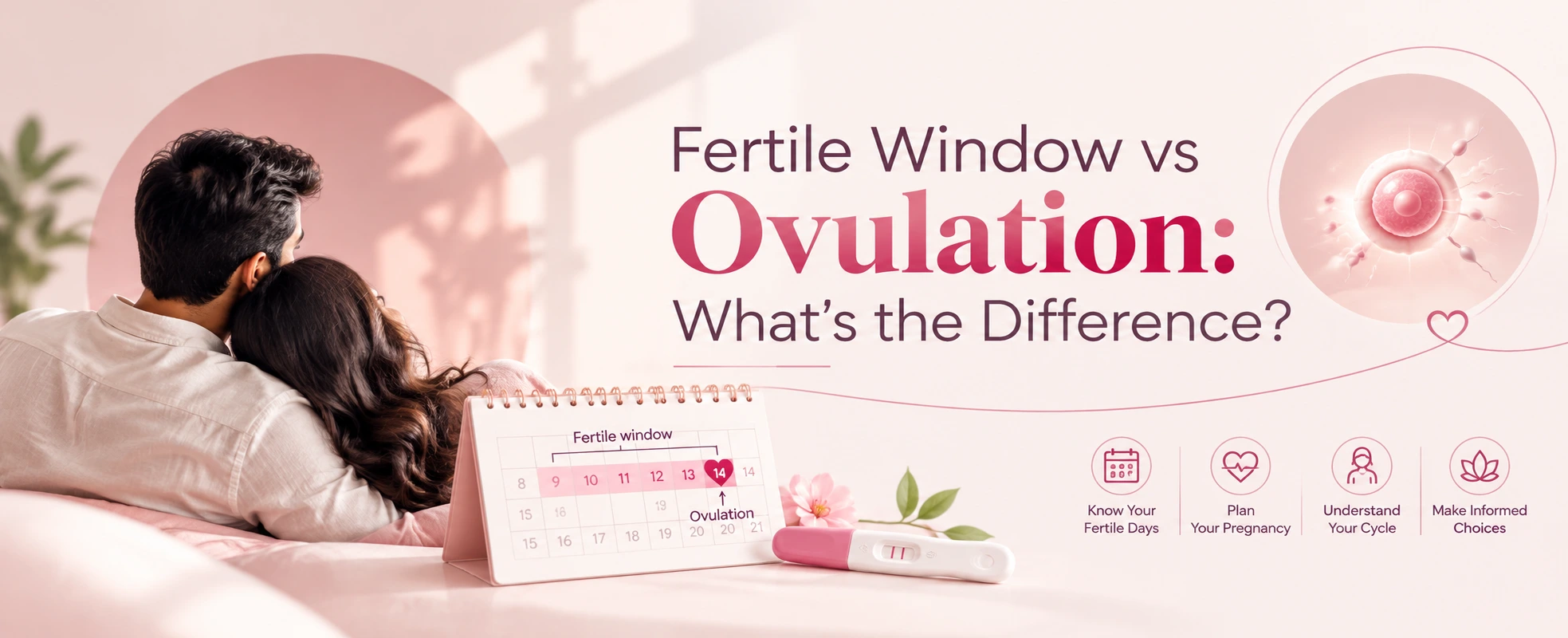
It generally includes the five days before ovulation and the day of ovulation. This is because sperm can survive in the female reproductive tract for several days under favourable conditions, while the released egg remains capable of being fertilised for approximately 12–24 hours.
This means pregnancy does not require intercourse to happen exactly on the day of ovulation. If sperm are already present in the reproductive tract when the egg is released, fertilisation may occur.
For couples trying to conceive, understanding the fertile window can help identify when to have intercourse without putting unnecessary pressure on one particular day.
What Is Ovulation?
Ovulation is the process in which a mature egg is released from one of the ovaries during the menstrual cycle.
Hormonal changes, particularly the rise in luteinising hormone (LH), help trigger the release of the egg. Following ovulation, the egg travels into the fallopian tube, where fertilisation may occur if sperm are present.
If the egg is fertilised and the resulting embryo develops and implants in the uterus, pregnancy may begin. If pregnancy does not occur, hormone levels eventually change and the uterine lining is shed during menstruation.
Ovulation usually occurs around 12–16 days before the next menstrual period, although the timing can vary between women and from one cycle to another. It does not always occur on day 14, even in women who have regular periods.
Fertile Window vs Ovulation: Key Differences
Understanding the difference between these two terms makes pregnancy planning easier.
| Feature | Fertile Window | Ovulation |
| Meaning | The days when intercourse can result in pregnancy | The release of a mature egg from an ovary |
| Duration | Approximately six days, including the five days before ovulation and ovulation day | The egg remains viable for around 12–24 hours after release |
| Timing | Begins several days before ovulation | Occurs within the fertile window |
| Biological role | Provides the opportunity for sperm and egg to meet | Makes an egg available for fertilisation |
| Pregnancy planning | Helps couples identify the days to have intercourse | Helps identify when the egg is released |
In simple terms: Ovulation is a specific event, while the fertile window is the broader period around that event when pregnancy is possible.
How Are Ovulation and the Fertile Window Connected?
The fertile window exists because sperm and eggs have different lifespans inside the reproductive system.
Sperm can survive for up to five days in favourable conditions, while an egg generally survives for about 12–24 hours after ovulation. As a result, intercourse in the days leading up to ovulation can still result in pregnancy
How to Identify Your Fertile Window
There are several ways to estimate the fertile window. Combining cycle tracking with physical signs or ovulation testing may provide a clearer picture than relying on calendar calculations alone.
1. Track your menstrual cycle
The first day of menstrual bleeding is counted as day 1 of the cycle. Ovulation often occurs approximately 12–16 days before the next period begins, rather than on the same calendar day for everyone.
For example, a person with a shorter cycle may ovulate earlier, while someone with a longer cycle may ovulate later. Calendar estimates are less reliable when cycles vary significantly.
2. Observe cervical mucus changes
Cervical mucus changes in response to hormonal fluctuations throughout the menstrual cycle.
As ovulation approaches, it may become more abundant, clear, slippery, and stretchy, resembling raw egg white. These changes can help indicate that the fertile window is approaching.
However, cervical mucus observations may be affected by vaginal infections, medications, intercourse, and other factors, so they should be interpreted in context.
3. Use an ovulation predictor kit
Ovulation predictor kits detect an increase in luteinising hormone (LH) in urine. A positive result usually suggests that ovulation may occur within approximately 24–48 hours.
These kits can help couples time intercourse, but a positive result does not confirm that an egg was released. A fertility specialist may recommend additional assessment if ovulation is uncertain.
4. Monitor basal body temperature
Basal body temperature is the body's resting temperature, measured immediately after waking.
A slight and sustained temperature increase may occur after ovulation because of hormonal changes. Tracking this pattern over several cycles may help identify when ovulation has already occurred, rather than predict it precisely in advance.
When Should You Consult a Fertility Specialist?
Understanding your fertile window can support natural conception, but timing intercourse alone cannot address every cause of difficulty becoming pregnant.
Consider seeking a fertility evaluation if:
- You have irregular or absent menstrual periods.
- You have been trying to conceive for 12 months if you are under 35, or for six months if you are 35 or older.
- You are over 40 and planning pregnancy.
- You have a known reproductive condition, previous fertility concerns, or other reasons to seek an earlier assessment.
These are general guidelines; a clinician may recommend an earlier evaluation based on individual medical history.
A fertility assessment may include a review of menstrual history, ovulation testing, ultrasound examinations, and semen analysis, depending on the couple's circumstances. Both partners may need evaluation because fertility can be influenced by factors affecting either partner